
Storytelling in Marketing: How to Connect With Your Audience
How to Connect With Your Audience
People don’t buy products. Not really. They buy how something makes them feel, the story behind it, the version of themselves they imagine after getting it. That’s always been true, but in a world where everyone is selling something, it matters more than ever. Storytelling is what separates a brand people forget from a brand people feel something about.
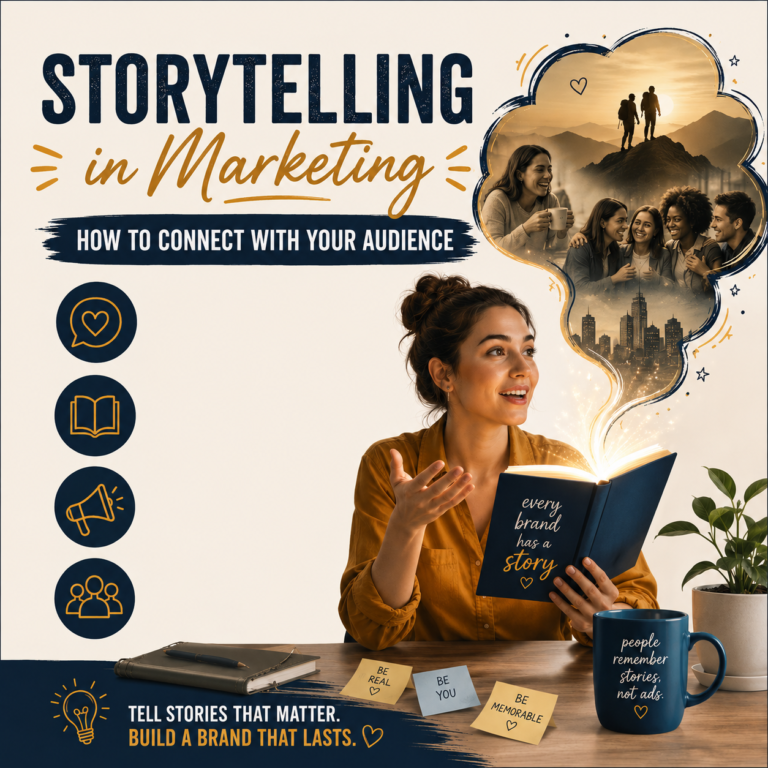
What Storytelling in Marketing Actually Means?
It’s not about being poetic or writing like a novelist. It’s simpler than that. Instead of saying “buy this” you’re saying “here’s what happened to someone who did.” Instead of listing features, you’re showing what changes. That shift — from selling to showing — is what makes people lean in instead of scroll past.
The best marketing never feels like marketing. It feels like a story you happened to stumble across at the right moment.
Why It Works
Our brains are not wired for data. They’re wired for narrative. You can throw statistics at someone all day and they’ll forget them by tomorrow. But tell them a story about a real person going through something they recognize — and it sticks. Sometimes for years.
Stories create emotional connection.
- And emotion, not logic, is what drives most of our decisions. We like to think we’re rational but we’re mostly just feeling our way through things and justifying it afterward. Good marketing understands that.
What Every Good Marketing Story Needs
The structure is less complicated than people think. You need a character your audience can see themselves in — not a perfect person, a real one. You need a problem, something that actually hurts or frustrates or holds them back. You need a solution, which is where your product or service enters naturally, not forcefully. And you need a transformation — what life looks like on the other side.
Before. Struggle. Solution. After.
That’s it. It sounds simple because it is. The execution is where most people overcomplicate it.
The Types of Stories Worth Telling
Your brand story is the most underused one. Why does your business exist? What drove you to start it? What do you actually believe in? People connect with founders and businesses that stand for something beyond making money. If there’s a real reason behind what you do, tell it.
Customer stories are arguably more powerful than anything you say about yourself. Real experiences from real people carry a weight that branded content just can’t match. A testimonial that sounds like an actual human being talking is worth ten polished ad campaigns.Behind the scenes content works because it breaks the illusion. People trust what they can see being made. Showing the process, the effort, the imperfect moments — it makes everything feel more real and more worth believing in.
Educational storytelling is the long game. Teach people something genuinely useful while weaving in who you are and what you do. When someone learns something from you, they remember you. And they come back.
Storytelling on Social Media
The rules are the same but the timeline is shorter. You have maybe three seconds to earn the next ten. That means the hook has to hit immediately — not eventually, not after a setup, immediately. A reel, a caption, a carousel — whatever the format, the first moment has to make someone feel something before they’ve decided whether to keep watching.
Short and real beats long and polished every time. The before and after, the honest moment, the thing you almost didn’t post because it felt too vulnerable — that’s usually the content that actually lands.
The Mistakes That Kill the Story
Talking too much about yourself is the biggest one. Nobody wants to read a love letter a brand wrote to itself. The story has to be about the customer — their life, their struggle, their transformation. You’re a supporting character, not the hero.
Inauthenticity is the other one. People can feel when something is performed. When the emotion is manufactured, when the testimonial sounds like it was written by a committee, when the “real moment” is too perfectly staged — it doesn’t land. It backfires. Authenticity isn’t a style choice in storytelling, it’s the whole foundation.
The Bigger Picture
When you tell better stories, something shifts. You stop chasing customers and start attracting people who actually care about what you do. They stay longer, spend more, and tell other people about you — not because you asked them to, but because the story you told made them feel like they’re part of something.
That’s what good marketing actually builds. Not just a customer base. A community that believes in what you’re doing.
And it all starts with being honest enough to tell a real story